
Let’s start
Sarajevo is the perfect spot for a weekend getaway. What we loved most was how untouristy it still is. It’s one of those rare European cities where you can still experience authentic local life, mainly because it’s not one of the usual must-visit capitals in Europe.
That said, Sarajevo is pretty small, so we wouldn’t recommend staying more than a couple of days. If you’ve got more time, we’ve heard it’s worth exploring the surrounding areas—though we didn’t get the chance ourselves, we kept hearing great things about Mostar and Konjic.
Efficiency tips
Transportation from the airport
A regular bus line called Centrotrans connects the terminal to the central station downtown at a very low price compared to taxis. The bus stop is just a 5-minute walk outside the airport. You can find the timetable at this link.
Buses run every 30 minutes, and a ticket costs around €3. You can buy it at the counter inside the terminal or directly from the driver. You can only pay with cash (either euros or the local currency), so make sure you have some small change.
Money
Always use your Wise or Revolut card for the best exchange, but be aware that many activities don’t accept cards.
For this reason, you can exchange your cash or there is one ATM without withdrawal fees: Ziraat Bank.
SIM card
Be careful: Bosnia and Herzegovina is not part of the EU, so your mobile network won’t work unless you pay for roaming!
Since we were only there for the weekend, we didn’t get a SIM card. Instead, we downloaded maps on Google Maps and connected to Wi-Fi whenever we found a network available.
Where to sleep
The best area to stay is the old town, Baščaršija, where you’ll find plenty of B&Bs, hotels, and budget-friendly guesthouses.
Authentic experiences
- Get lost walking around Baščaršija, the heart of the old town
- Try all the typical Bosnian dishes
- Catch a traditional Bosnian coffee experience
- Do a free walking tour to learn about the country’s history
Itinerary
DAY 1
We started our visit to Sarajevo with a walking tour to get a feel for the city.
We highly recommend the one we did—our guide, Adis, was super friendly and fun. You can contact him through Guruwalk or directly at their office. He’s a historian, so the tour was not only entertaining but also very detailed and insightful. With this tour, you will cover the most touristic areas of the city.
We walked through Baščaršija, where we saw Sebilj, an Ottoman-style wooden fountain. From there, we strolled down Kazandžiluk Street, lined with traditional copper shops, where artisans still handcraft goods like they’ve done for centuries.
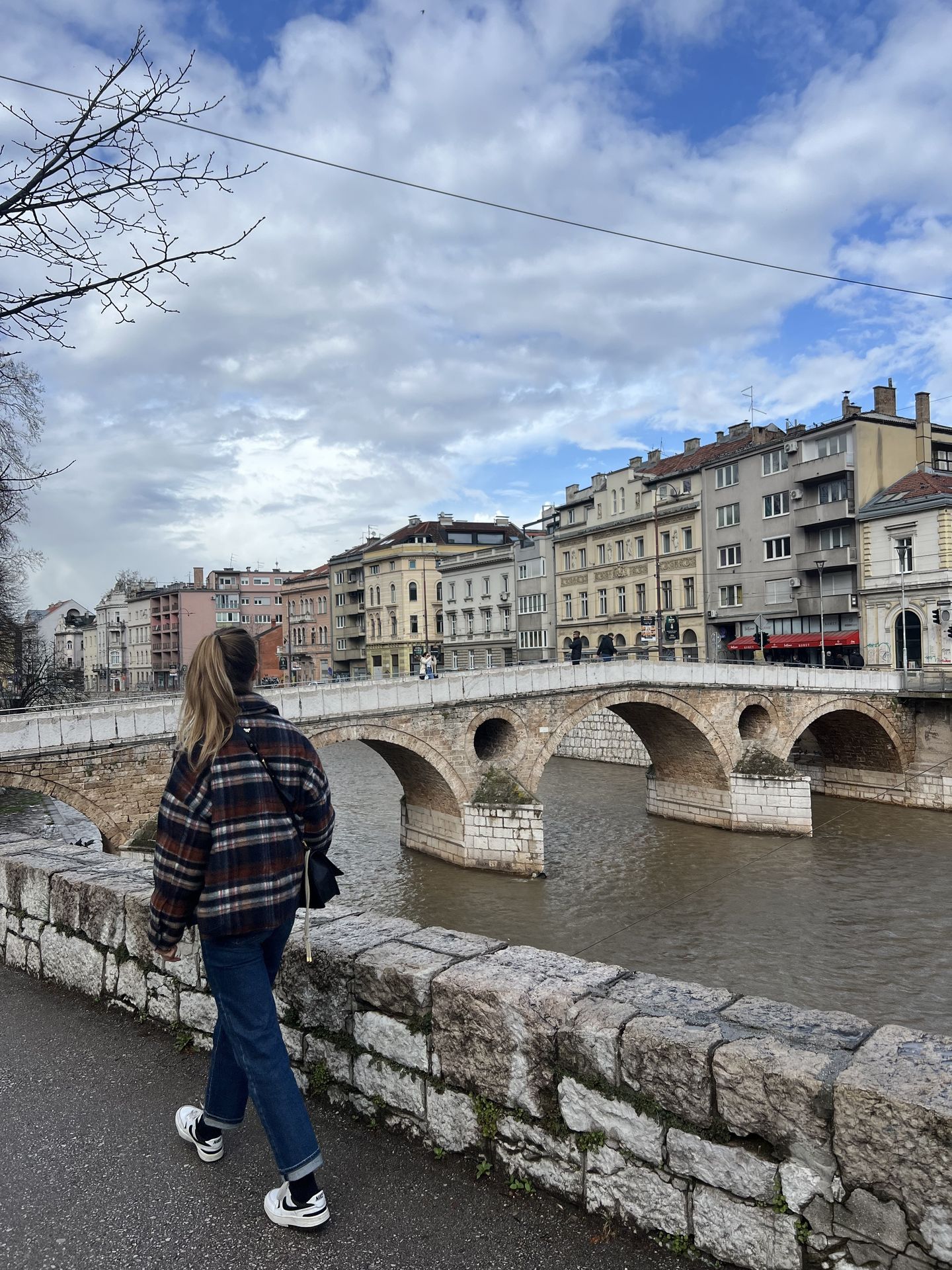
Next, we passed by the Sarajevo City Council, admired the Emperor’s Mosque, and continued toward one of the city’s most popular landmarks: the Latin Bridge. This is a famous spot because it’s close to where the assassination of Archduke Franz Ferdinand took place, an event that supposedly triggered the start of World War I.
Then we walked to the Gazi Husrev-begov Bezistan market and saw the Gazi Husrev-beg mosque. We discovered the story of Hotel Europa, the Orthodox Cathedral of the Theotokos, and the Catholic Sarajevo Cathedral.
Finally, we saw the rose of Sarajevo, a memorial of a mortar shell’s explosion that was later filled with red resin. Near here, you’ll find the Genocide Museum, which we unfortunately didn’t have time to visit, but it’s highly recommended.
Since we had already explored the historic, Ottoman side of the city, we decided to head towards the newer part, which has a much more European vibe in terms of architecture.
We passed by the Gradska Tržnica, a big and nice food market.
We walked the “shopping street” of Ferhadija to the Dolac Malta area, stopping at the iconic Café Tito.
After a nice dinner in the city center, we went to City Pub for a beer and live music. That street (Zelenih beretki) is full of bars. Walk around this area if you are looking to find some nightlife.
Of course, you can’t say you lived the full experience if you don’t wrap up your night with a nice kebab from Pasa Doner.
DAY 2
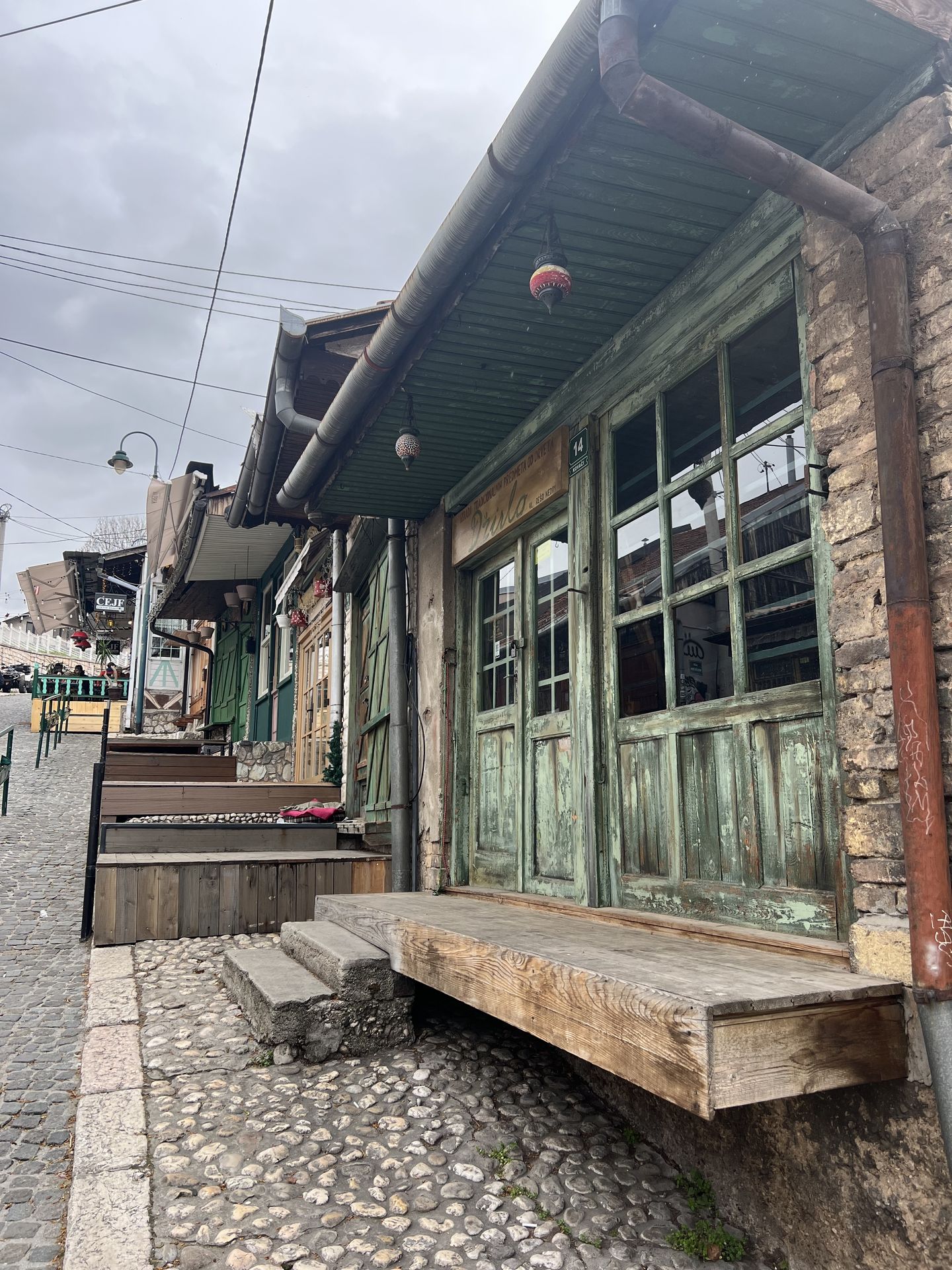
We started our day at a café that every local recommends: Ministry of Ćejf.
Then we walked up to the Yellow Fortress, passing by the cemetery of Kovači. After that, we quickly stopped at Kamarija—a cozy little café with a great view.
We spent the rest of the morning browsing the souvenir stalls in the Baščaršija bazaars. In particular, we returned to Kazandžiluk Street to buy a Bosnian coffee set. Many items you’ll find here are hand-made, but others are indeed artificial replicas produced by machines. If you’re buying anything, we recommend asking in different shops to compare prices and be sure that what you’re paying for is actually worth that value (of course, manually-crafted items should be more detailed and beautiful, but also more expensive).
Finally, to wrap up this fantastic weekend, we grabbed a delicious lunch and hopped on the bus back to the airport.
Food
Bosnian cuisine is delicious. Even though we didn’t have so many meals as to try all their typical dishes, the ones we had were more than enough to make us fall in love with their food.
The most traditional dishes that we tried were:
- Ćevapi (grilled minced meat typically served with onions, kajmak, and lepinje–kajmak is a dairy cream and lepinje is Bosnian pita bread).
- Burek (a savory pastry made with thin layers of dough and filled with seasoned minced meat–it was so good that we had to try it more than once).
- Zeljanica (similar to burek, but filled with spinach or other greens and cheese).
- Klepe (meat dumplings traditionally topped with a sauce based on garlic and yogurt).
Besides traditional dishes, you will find mind-blowing desserts in Sarajevo and, most importantly, very unique and high-quality coffee.
Before heading to any particular shop or restaurant, remember that if you’re in Sarajevo during Ramadan, their timings may differ, so check them out before.
Here is the list of all the food-related shops we recommend in Sarajevo:
- Ćevabdžinica Hodžić: Recommended by our walking tour guide, this place didn’t disappoint. We ordered the mix of ćevapi with sausages, and to go in local mode, we also had a yogurt with the meal. The whole order was 15 KM, which is quite fair. Avoid coming here if you’re a vegetarian–there won’t be many options for you!
- Buregdžinica Oklagija: An outstanding savory pies shop. We tried a lot of stuff, and all of them were insanely good. In particular, their burek was, in our opinion, the best we tried during our trip. The prices are SUPER fair, and the lady working there is super friendly and efficient. It’s right in front of Ćevabdžinica Hodžić, so if you are in a group and some of you are vegetarian and some are not, it’s a good strategy to split between these two places to eat and join back again later.
- Pie shop “Forino”: Really good burek outside of the city center for a more local, less touristy vibe. The prices are ridiculously cheap. We had slices of four different pies: meat and garlic, spinach, potato, and zucchini. The total cost was 11.50 KM for two, and both of us were more than full!
- Staklo: We came here to try the klepe (9 KM) and we also had a kombinacija (9 KM), which we believe stands for “a combination of things”. Both dishes were great, and the flavor and portion sizes were perfect. They also gave us a lot of lepinje for free, included in the meal, which is always a nice detail.
- Cream Shop: This is THE spot in Sarajevo to have a powerful sweet breakfast or some dessert after your lunch elsewhere. The quality of these desserts is outstanding, and the prices are so cheap it’s unbelievable. Their cakes are mind-blowing. We recommend the Ambassador cake (pistachio, chocolate, and berries–6 KM a piece), the Jaffa Cake (orange and chocolate–4.5 KM), and, of course, the baklava and the kadaif (which are good, but nothing compared to the cakes). The only issue is that they only have takeaway (at least when we went), so no coffee or tea was available, nor the possibility of eating at a table.
- Ministry of Ćejf: Probably the most popular café in Sarajevo. It has a beautiful view, and the spot itself is charming. The price is 5 KM for a Bosnian coffee, which is a bit more expensive than the average price in other places.
- Teahouse Džirlo: This teahouse offers a unique experience. They have a HUGE variety of teas (all of them for 5.50 KM), and you can order Bosnian coffee (4 KM) as well. The place is beautiful, and the guy who prepared the beverages for us was super kind and friendly. Unless you don’t mind waiting, head here early because the place is tiny and there are few available tables.
- Bakery Alifakovac: If you’re a pita bread lover, you must pass by this bakery. They only sell Bosnian pita bread (lepinje). We saw a big queue outside this place while visiting Sarajevo due to the fasting times during Ramadan. Their bread is delicious and freshly made, so it’s no wonder everyone wants to break their fasts by buying bread there.